Xavier A. Jenkins, PhD
Vertebrate Paleontologist and Functional Morphologist
Recent work with my collaborators finds strong anatomical support for the evolutionary origin of turtles in the tree of life (Current Biology), and demonstrates that anatomical traits long considered to be terrestrial hallmarks of early tetrapods evolved in aquatic and amphibious contexts (Nature).
I am a vertebrate paleontologist studying how major shifts in habitat and body plan reshaped the functional biology of early vertebrates and how they interacted with their environment. My research combines biomechanical methods and functional morphology with comparative anatomy, µCT imaging, and phylogenetics to study these macroevolutionary processes and reconstruct functional neurosensory systems in fossil tetrapods, including those related to hearing, respiration, and locomotion.
I completed my B.S. in Biological Sciences and Anthropology at Arizona State University and my Ph.D. in Biological Sciences at Idaho State University, where I worked on the anatomy and relationships of Paleozoic amniotes. I hold an NSF Earth Sciences Postdoctoral Fellowship at the American Museum of Natural History in New York, where I investigate the deep-time origins of sensory systems — including tympanic hearing in early terrestrial vertebrates — alongside the phylogenetic relationships of early tetrapods.
My current focus is the fin-to-limb transition, where these questions converge. Work on Westlothiana (Nature), long interpreted as one of the earliest amniotes, instead reveals an animal with an ossified internal gill skeleton, underwater feeding habits, and limb proportions associated with swimming, evidence that anatomical features associated with terrestriality in the past were assembled in aquatic or amphibious contexts. I am now tracing that assembly across the water-to-land transition, integrating branchial, locomotor, and sensory anatomy to ask which systems changed first and why.
Featured in
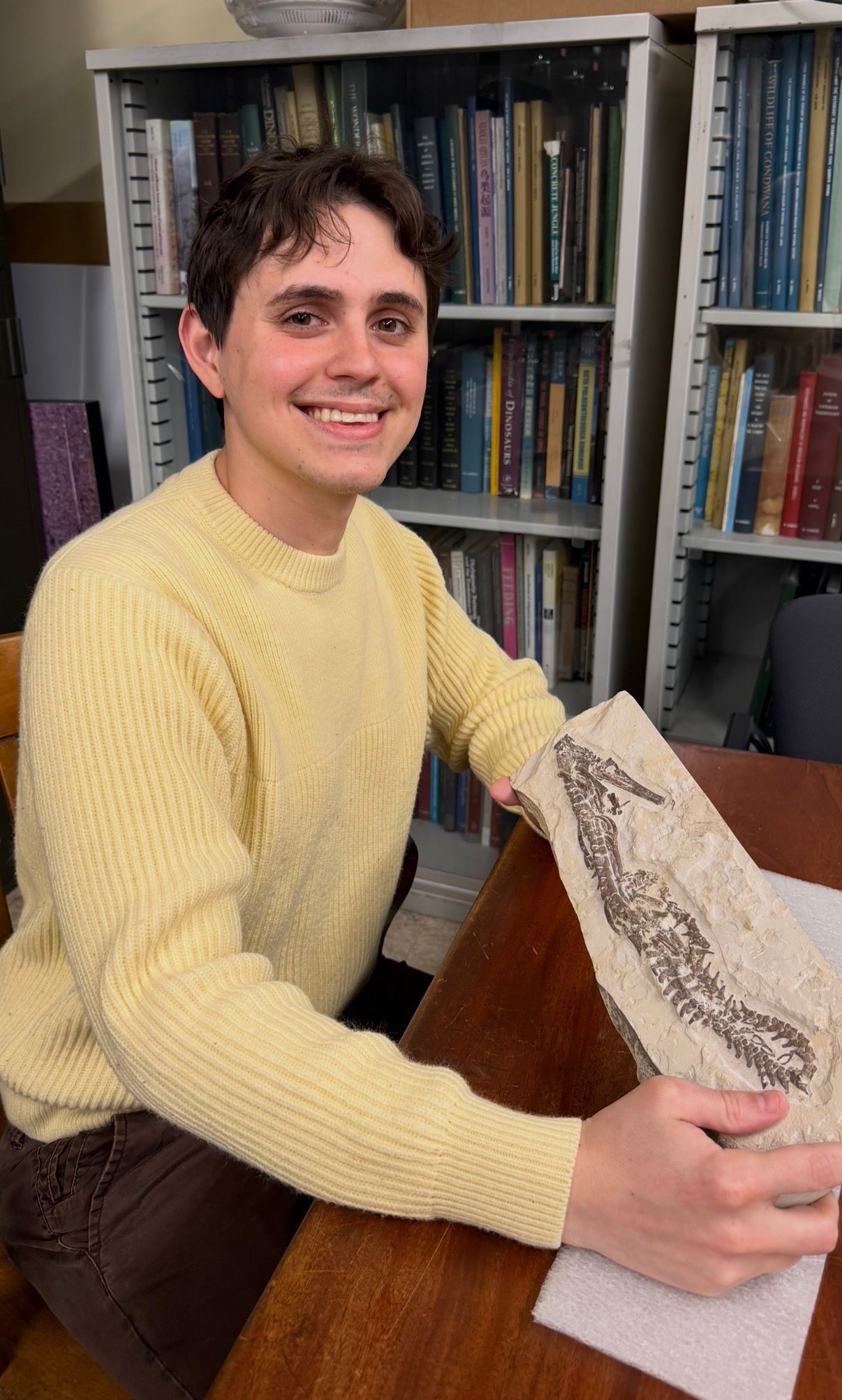
Xavier with a fossil of the early reptile Mesosaurus tenuidens from the early Permian of Brazil.
Recent Highlights
View all media & press →The phylogenetic origin of turtles(opens in new tab)
Our study resolving where turtles sit in the reptile family tree, using synchrotron scanning of Permian fossils.
Current Biology · 2026Turtles All the Way Down to … What Exactly?(opens in new tab)
The New York Times reports on our research resolving the evolutionary origin of turtles and where they belong in the reptile family tree.
The New York Times · 2026Evolution of terrestrial anatomy revealed by a derived stem tetrapod(opens in new tab)
Our work on Westlothiana reveals that traits long considered terrestrial hallmarks evolved in aquatic and amphibious contexts. Co-first author.
Nature · 2026